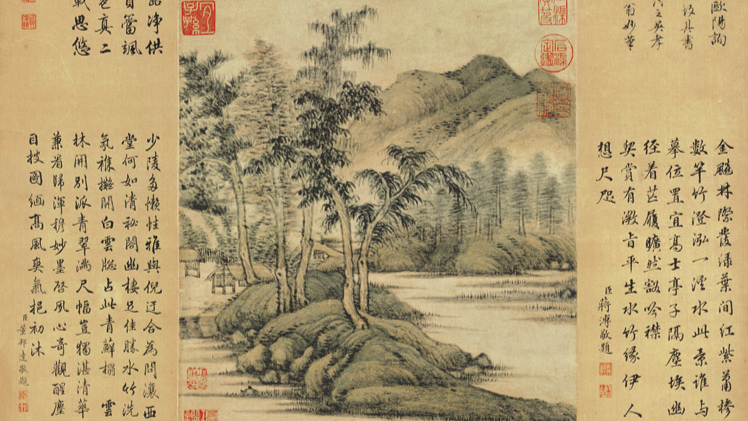
The Water-Bamboo Dwelling
Introduction
The Water-Bamboo Dwelling, or Shui Zhu Ju Tu (水竹居图) in Chinese, stands as a revered hanging scroll from the Yuan Dynasty, measuring 53.6 x 27.7 cm, and serves as a quintessential showcase of the ink and color on paper technique that characterized the era.
Crafted in 1364, this minimalist landscape masterpiece encapsulates the essence of the natural world with a serene and desolate beauty, emblematic of the esteemed status of scholarly arts during the Yuan Dynasty. Noteworthy for its three-part composition depicting widely separated riverbanks connected by expansive stretches of water, the painting resonates with a profound sense of depth and tranquility.
Maestro Behind the Brush: Ni Zan
The visionary artist behind this masterpiece is Ni Zan (1301-1374), a luminary of the Yuan Dynasty renowned for his significant contributions to Chinese landscape painting. His deliberate choice of a reclusive lifestyle enabled the cultivation of a distinctive artistic style that continues to echo through the annals of time.
Artistic Flair and Structural Brilliance
The Water-Bamboo Dwelling exemplifies Ni's minimalist artistic approach, diverging from the opulent and intricate landscapes characteristic of the Southern Song (1127-1279) academy. His compositional finesse often embraced a three-part structure, seamlessly intertwining foreground elements with distant vistas through expanses of tranquil waters, evoking a profound sense of serenity and spatial depth.
Cultural and Historical Reverberations
Ni Zan's artistic oeuvre transcends mere aesthetic pursuits to embody a potent cultural declaration. His tranquil and precise demeanor finds resonance within his paintings, serving as a testament to his yearning for seclusion and contemplation of nature. The Water-Bamboo Dwelling materialized during a phase when Ni Zan delved deeply into Daoist practices, fully solidifying his mature artistic style.
Technical Brilliance
From a technical standpoint, Ni Zan's adept use of ink in The Water-Bamboo Dwelling is masterful, predominantly executed in monochromatic hues that enhance the work's ethereal quality. The inclusion of inscriptions imparts a personal touch and historical context, divulging details such as the creation date and the artist's age at the time of inception.








